
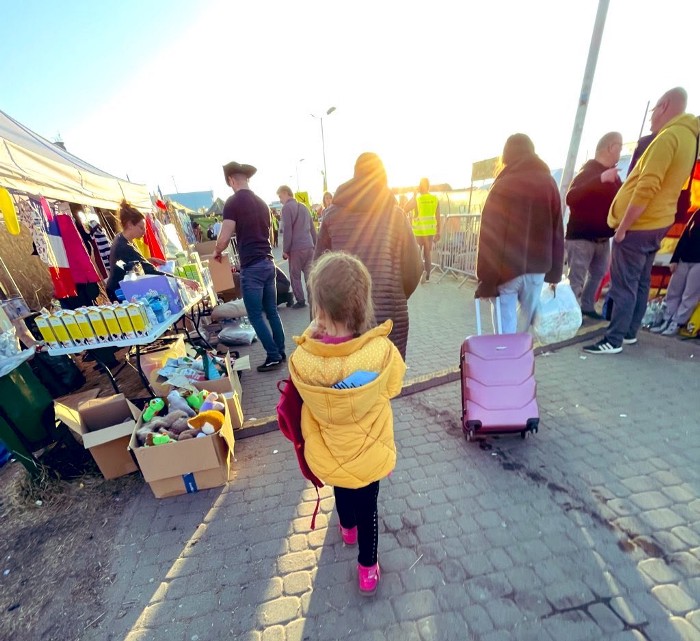
Joining The Effort:
The Russian invasion of Ukraine and its respective effects are rightfully catching the sympathy and attention of people around the world. Many around the world are calling out for the safety of the refugees, and yet, despite the number of such individuals interested in aiding those driven from their homes, many are unsure where to start helping. One such individual, Elena, was in a similar situation when the conflict began. Despite not being sure of how to help the fleeing refugees, one thing was clear: the loving wife, mother, and budding human rights activist understood that something needed to be done. As a refugee of the Soviet Union who had fled Ukraine in 1989, Elena personally resonated with the ongoing crisis. After immigrating to the United States as an adolescent, Elena would later become a professional in the tech industry and more importantly to her, a mom. Now, when she happens to find free time, Elena loves running, speaking about various topics including civil rights, and “writing to inspire future leaders.”
Elena knew she had found a window of opportunity when her sister connected Elena to a church-affiliated organization. Once a missionary establishment hosting summer camps in Ukraine, the organization (like many others in Ukraine) recently shifted its focus to providing humanitarian aid. The organization sends supplies to Ukraine and provides a way for Ukrainian refugees to move out of dangerous hotspots.
Preparation For the Journey:
The plan for Elena and other volunteers traveling with her was to raise money, buy supplies refugees may need, and then travel to target sites where aid could be distributed to the refugees. Elena had shared that the initial preparation for the trip was a mix of chaos, dedication, and generosity. Amazingly, within a week before her flight to Poland, Elena and other volunteers had already raised $45,000, which was well past their initial goal of $7,000. These funds were then used to purchase medicine, toiletries, and toys from certain stores (like the one and only Costco). In addition, others were also planning on personally contributing a multitude of supplies—ranging from medical supplies to children’s toys—that would be delivered as well.
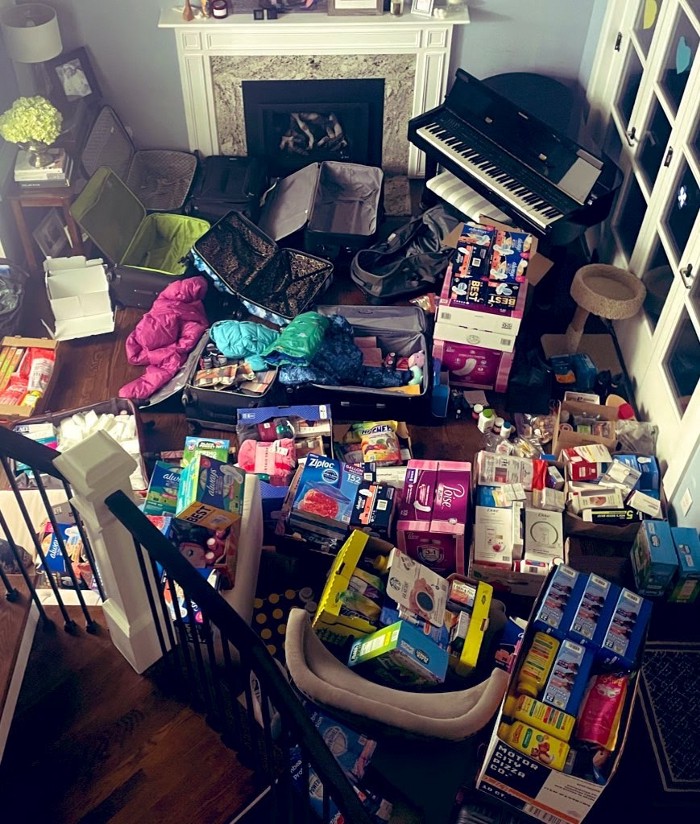
Elena’s living room full of supplies
But alas, nothing always goes as planned and in this case, Elena and her group found themselves unable to connect with a team able to provide housing and transportation. She shares that [the] welcome guidance she got could best be summed up as “Great, we believe in you, now show up and figure it out.” They managed to figure it out themselves and organized a plan for hotels and transit. The last challenge to be conquered was the packing itself. With a living room resembling a storage facility, the group had to spend a whole day and night to finish preparing all the supplies for the trip. Elena was extremely grateful for her family’s support and knows without them she wouldn’t have been able to finish packing. However, she shared with us that her gratitude didn’t stop her from leaving a mountain of wrappers, boxes and plastic for her spouse and children to clean up! Ultimately, Elena and the other volunteers had to manage thirty-four suitcases, and that’s excluding their personal luggage!
Humanitarian Aid and Connection
After arriving in Poland, Elena’s group began volunteering at a transportation system before moving to areas closer to the Polish/Ukrainian border. For the rest of the trip’s duration, they would help out in three distinct places. Each place had their own distinct challenges that Elena’s group had to alleviate.
The first destination was the Krakow Main station, a bustling bus and train station located in southern Poland, which was connected to a mall where several Ukrainian refugees were staying before passing the border. Here, Elena admits to the group’s initially slow action and attributed it to their inexperience. Fortunately, this was the prime time for her group to adapt and learn the skills needed to become a good volunteer! Many exhausted refugees trailed in asking about where to go next, and Elena’s group cleverly utilized posters on the front of the shelter wall to glean more information. There were always more seasoned volunteers to nag as well, so Elena’s group rapidly improved. They compiled the information into a document, which they used to direct and inform the refugees to potential next destinations to find safety and shelter. Elena also helped around the shelter by taking advantage of her rusty but still applicable knowledge of the Russian and Ukrainian language.
Many of the Ukrainian refugees predominantly spoke Russian while a good amount of the volunteers were Polish. Conveniently, the Ukrainian and Polish languages are quite similar, so Elena could translate what the refugees had said or asked into Ukrainian so other Polish volunteers could roughly get the gist. As Elena interacted with the displaced peoples, she realized that the term “refugee” invokes a sense of pity, but that does not define the people she met. While they were “exhausted and scared,” they were simultaneously brave people who, when forced to flee their homes, found the motivation to keep moving forward.
Later, her group moved closer to the areas of action: volunteering at the border, a nearby refugee center and a hotel hosting an orphanage. At the Polish end of the border, a line of large tents surrounded the path that would eventually lead to the passport control. At the tail of this path, a line of buses brought people to the corresponding refugee center. Elena and her group went against the steady flow of refugees to reach the passport control. They were required to cross a barbed corridor by foot to “leave” Poland and “enter” Ukraine.
At the Ukrainian/Polish Border
Elena personally noticed the stark contrast between the Polish side of the border and the bleak Ukrainian side. At the border, Elena’s team started to pass out food to the refugees that were lining up. On the surface, pouring curry over rice seems like a menial task, but Elena found it more meaningful as she was providing much needed nourishment and comfort to exhausted refugees. When some refugees complained that the curry was too spicy and Elena had to dilute it, she stated that “everyone was trying to do their best [to help] and when we knew better, we did better.”
In an effort to partially rejuvenate the atmosphere on the Ukrainian side of the border, Elena and her cohort brought camping chairs and started activities to entertain the displaced children. Other small volunteer organizations contributed similarly, and soon, basic accommodations such as benches, chairs, tables, and snacks were awaiting those exiting Ukraine. Personal donations also accounted for a portion of the surge in aid, but despite the donations, the Ukrainian side could not compete against the Polish side, a stark reminder of the burdens of war. Elena attributes the difference to the inability for larger nonprofit organizations to seep through to the other side, as all the groups she and her cohort partnered with were on the smaller scale. But there was a silver lining: this provided opportunities for an individual’s contributions to be effective! A single person’s actions–whether it be physical volunteering or donating–can help to ease the refugees’ discomforts.
The last place Elena and her group volunteered was at an orphanage hosted in a nearby hotel. Because of the surplus of Ukrainian children displaced from the war, the local Polish school that the orphanage initially toured could not accommodate any more kids. To make up for this lack of space, the orphanage created its own educational curriculum. Like a boarding school, the orphanage split kids off by age groups after eating in the cafeteria and meeting in the auditorium. Elena was in charge of caring for the first and second graders. With kids of her own, Elena rightfully felt emotional for these children as they had no “forever family,” but she was touched to see that many of the older siblings “[took] a parental role to the younger ones.” Even more saddening were the events witnessed by these children. They shared with Elena the frightening sound of gunshots and the sight of people frantically banging on bus windows to be let in for evacuation as well. At the sound of air raid sirens, these young ones would refuse to walk through interior buildings that had windows for fear of bombing. Even worse, these innocent kids would react terribly to airplanes, with many remarking that they would get killed. Elena hopes to emphasize the impact the conflict has on children, with all too many harboring emotional scars and frights from this life-changing experience. Their trauma makes Elena’s work even more meaningful, with her even stating that the volunteers were coached to “raise these children to be well rounded, kind and productive members of society that the great country of Ukraine would be proud of.”
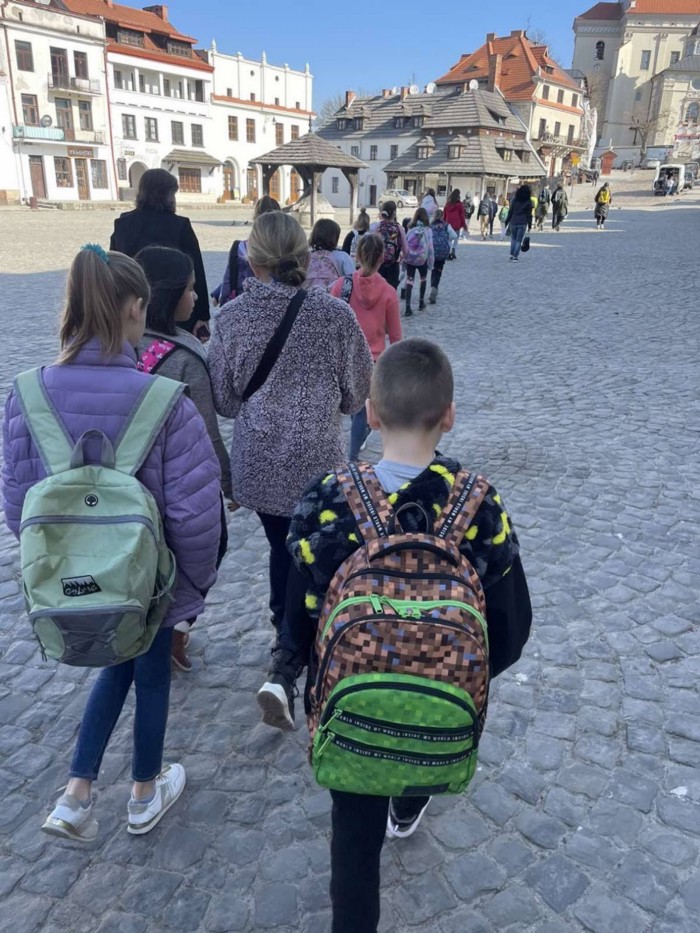
Walking with kids from the Mariupol orphanage
In spite of her (prior) inexperience and challenges that had to be faced along the way, Elena’s humanitarian journey made a real impact on people’s lives. Earning the appreciation of the grateful refugees, Elena and her team were able to accomplish a lot at the Krakow Main station, Polish border, and the orphanage. Their aid largely came in the form of easing the refugees’ immigration, providing care for the children, and just general volunteer labor. Her work would not have been made possible without the support of her family and the flexibility of her employer, so Elena is extremely thankful to them! All in all, Elena found her trip across the Atlantic Ocean to be an enriching eye opener. Looking back, she comments: “[in] many ways, I miss it now. Going back to donating money feels transactional and distant. It robs me of the aura, the smell, the energy of my people. I empathize with the people who want to volunteer but can’t. And at the same time I cry that such an opportunity has to exist.”